
Printed Socks, Actually Explained: Sublimation, Knit-In, and How to Choose the Right Method for Your Sock
 By Tang Wanlan— views
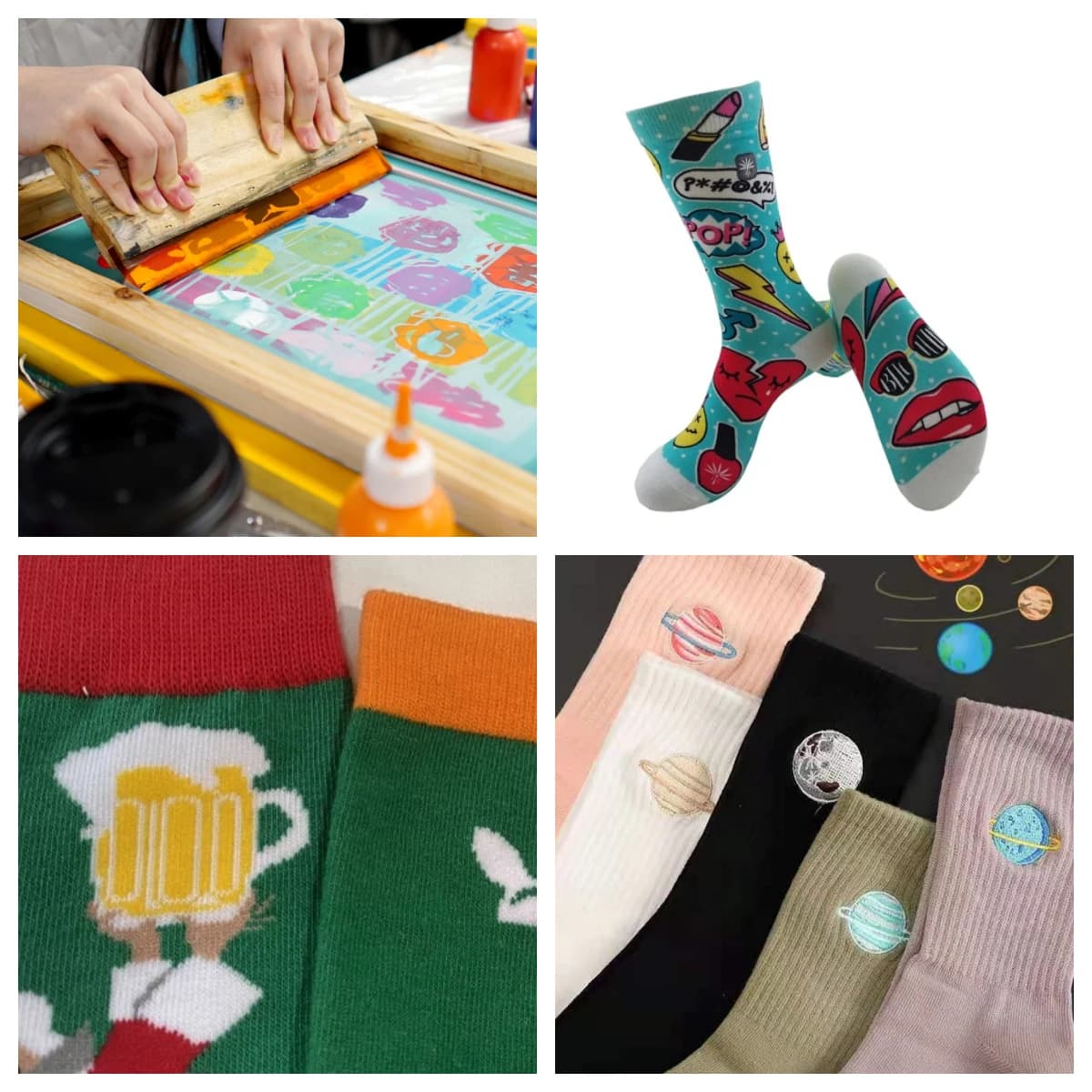
"Printed socks" is one of those phrases that sounds simple until you try to order them. Ask five suppliers what "print" means and you will get five different answers-some talking about dye sublimation, some about knit-in jacquard, some about DTG, and some quietly hoping you will not notice which one they are quoting. The confusion is not academic. The method used to put a design on a sock determines how long the design lasts, how the sock feels on the foot, what kind of artwork is even possible, and what the order costs at the quantity you actually need.
This guide does what most sock "print guides" avoid: it separates the methods, explains what each one is genuinely good at, and tells you which sock type each method belongs in. By the end, you will know why a full-color photographic design and a two-color corporate logo are not the same order-and why treating them the same is the fastest way to waste money.
The first distinction: "printed" does not mean one thing
In custom sock production, the word "printed" is used loosely to cover any sock with a design applied after knitting-or, in the case of knit-in construction, a design built directly into the knit structure itself. That loose usage causes real problems for buyers comparing quotes. A sublimation sock and a knit-in sock can look similar in a product photo and perform very differently in real-world wear.
The practical split is between structural color and applied color. Knit-in socks build the design from colored yarn during the knitting process; the color is the fabric, not a coating sitting on top of it. Sublimation, DTG, and screen printing apply color to a finished or pre-knitted sock surface. Each approach has a different ceiling for detail, durability, and color range-and each one belongs in a different kind of order.
Knit-in (Jacquard): the durability standard
Knit-in is the traditional and most widely used method for custom sock production, and it remains the benchmark for brand programs and retail lines where the sock needs to survive repeated washing without losing its appearance.
The design is literally built into the sock during knitting. Different colored yarns are knitted into specific stitch positions, row by row. When the sock stretches, the design stretches with it. Colors stay solid and edges stay sharp because the yarn itself carries the color rather than a surface coating. There is nothing to crack, peel, or fade away from the fabric.
The constraint is color range. Standard knit-in production supports roughly 6-8 yarn colors per design, and photographic or photorealistic imagery is not achievable because the design is built from discrete yarn colors, not blended ink. Fine detail is also limited by the gauge of the knitting machine; very small text can be difficult to resolve cleanly.
What knit-in is for: logo-based designs, geometric patterns, team branding, corporate socks, retail product lines, and any application where the sock will be worn and washed as an everyday item. If the design uses six colors or fewer and does not require photographic gradients, knit-in will outperform sublimation on durability, hand feel, and wash longevity every time.
Dye sublimation: full-color capability, with conditions
Sublimation is the method most people mean when they say "printed socks," and it is the only practical route to certain kinds of artwork.
The process uses heat to convert solid ink into gas, which then bonds permanently with polyester fibers at a molecular level. Because the ink becomes part of the fiber rather than sitting on the surface, a sublimated design will not crack or peel in the way a surface-applied print can. This is the method that enables unlimited colors, photographic imagery, and smooth gradients on a sock.
The conditions are non-negotiable. Sublimation requires a polyester-dominant sock, typically 65% polyester or higher, and a white or light-colored base for the dye to bond visibly. Cotton and bamboo socks need entirely different chemistry-DTG or reactive dye systems-and running cotton on a sublimation line is a fast way to ruin a batch. The hand feel also changes: a polyester-heavy sock feels different from a cotton sock, and for some wearers that difference is the deciding factor.
What sublimation is for: all-over photographic prints, complex gradients, novelty socks, photo-personalized gifts, and designs where color range matters more than the classic cotton hand feel. It is also the method that makes low-volume full-color work accessible, which matters for brands testing a concept before committing to a larger knit-in run.
DTG (direct-to-garment): small batches, cotton-friendly
DTG applies ink directly to the fabric using a digital printer, with minimal setup. It works on a wider range of materials than sublimation, including cotton and cotton blends, and it handles both light and dark-colored socks better than a sublimation process that depends on a white base.
The trade-off is durability. DTG is the cheapest and least durable of the three main methods for socks that will be worn and washed repeatedly. It belongs in small-batch orders, samples, prototypes, personalized gifts, and one-off promotional items, not in a retail program where the sock needs to survive a full season of wear.
What DTG is for: a 10-pair test run for a client pitch, a short-run gift for a specific event, or a design that needs to land on a cotton sock at a quantity too small for knit-in tooling to make sense.
Screen printing: cheap for simple logos, limited everywhere else
Screen printing pushes ink through a mesh screen onto the fabric. It is cost-effective at large quantities for simple, solid-color designs, and it produces vibrant results on flat surfaces.
On socks, however, the method runs into structural problems. The ribbed, curved, stretchy surface of a sock does not accept a uniform, crisp screen print cleanly. The ink sits as a film on top of the fabric, which traps moisture and can crack under the daily strain a sock experiences. Multi-color work requires a separate screen for each color, which adds setup cost and makes the method inefficient for small or frequently changing orders.
What screen printing is for: a simple one- or two-color logo on a large promotional run where cost per unit is the dominant concern and the sock is a giveaway rather than a daily-wear item. It is not the right method for a design with detail, gradient, or long-term wear expectations.
The decision framework: match the method to the sock
The method should follow the use case, not the other way around. The following table maps common order types to the method that fits them.
| Order type | Recommended method | Why |
|---|---|---|
| Corporate logo socks | Knit-in | Durable, premium hand feel, design survives washing |
| Retail brand program | Knit-in | Structural color, consistent quality at scale |
| Team or club socks | Knit-in | Bold blocks and repeats translate cleanly from yarn |
| Photographic / novelty socks | Sublimation | Unlimited colors, gradients, photo-realistic detail |
| Full-wrap all-over print | Sublimation (360° rotary) | Seamless coverage around the entire sock |
| Small-batch samples / gifts | DTG | Low setup, cotton-compatible, one-off friendly |
| Simple high-volume giveaway | Screen printing | Lowest cost for solid-color simplicity |
| Mixed-material premium line | Knit-in base + printed panel | Structural durability where it matters, color where it counts |
Two rules sit underneath that table. First: if the sock will be worn and washed as a normal sock, knit-in is the default. The design is part of the fabric, so there is nothing to degrade independently of the sock itself. Second: if the design requires photographic color or gradients, sublimation is the only method that delivers it-but only on a polyester base. Do not ask a cotton sock to behave like a sublimation sock, and do not ask a knit-in program to reproduce a photograph.
What this means at SoxFun
SoxFun's production model is built around the reality that buyers often need to test a method before committing to a full run. The 50-pair minimum means a buyer can validate a design on a small batch before scaling, or order a knit-in sample to compare hand feel against a printed alternative without absorbing a 300-pair commitment. Free design support exists for the same reason: the method decision is easier to make when someone who runs the knitting and printing programs reviews the artwork against what each process can actually produce.
The right question is not "Can you print this?" Almost any supplier can print almost anything once. The right question is "Which method makes this sock worth wearing for the life of the product?" Knit-in for the socks people keep. Sublimation for the socks people photograph. DTG for the socks you need ten of by Friday. Screen printing for the socks you need ten thousand of at the lowest possible unit cost. Match the method to the job, and the sock does the rest.