
Understanding Sock Sizing for Bulk Orders: A Buyer's Guide to Getting Fit Right the First Time
 By Shen Yunzhi— views
Sizing is the quiet failure point in most custom sock orders. The design looks sharp in the mockup, the yarn colors match the brand palette, the production timeline holds-and then the socks arrive, and a third of the recipients cannot wear them comfortably. The heel sits too high on some feet, the toe bunches on others, and the "one size fits most" promise turns out to fit most people sort of, which is not the same as fitting them well.
This is not a design problem. It is a sizing problem, and it is solvable before a single pair is knit. SoxFun's size guide exists for exactly this reason: to turn sock sizing from a guessing game into a set of decisions a buyer can make with confidence. What follows is how to use it-and what the guide reveals about the deeper logic of getting fit right at volume.
The first decision: One size, or a size split?
The most consequential sizing decision in a bulk order is not which size to choose. It is how many sizes to offer.
A "one size fits most" option is genuinely useful for a certain kind of order. SoxFun's one-size range covers foot length 24-27 cm, which translates to US Men 5-9.5, US Women 7-11, and EU 38-43. For an event giveaway, a welcome kit, or a team where individual sizes are unknown, this eliminates the need to collect a size matrix, reduces exchanges, and speeds up production. Industry guides make the same case: one-size socks are logistics-friendly because there is no sizing grid to manage and no fit-related returns to process.
But "one size" is a range, and ranges have edges. A buyer ordering for a group with a wider spread-a warehouse team, a sports club, a mixed office with a meaningful number of people outside the 5-9.5 men's band-will get better results from a size split. SoxFun's guide offers a concrete starting distribution for adult unisex orders: 10% S, 35% M, 40% L, and 15% XL. That bell-curve logic mirrors what production specialists recommend across the industry: adjust the ratio based on who is actually wearing the socks, skewing toward L and XL for men's sports teams and toward M for a mixed office, and refine with real measurements whenever possible.
The practical rule is straightforward. If you know the group, split. If you do not-or if the order is a broad giveaway where a precise fit is a bonus rather than a requirement-one size is a legitimate, efficient choice. The mistake is assuming one size is always enough, or that a split is always necessary. The right answer depends on the recipients, not the supplier's default.
The second decision: Measure the foot, not the shoe size
Shoe size is a proxy, and a loose one. It varies by brand, by country, and by how a person prefers their shoes to fit. The most reliable sizing input in a custom sock order is foot length in centimeters, measured heel to longest toe.
SoxFun's guide lays out the method without overcomplicating it: measure in the afternoon or evening, because feet swell slightly over the course of the day; stand barefoot on a sheet of paper on a hard floor; mark the heel and the tip of the longest toe; measure the distance in centimeters; and match that number to the chart. If the measurement falls between two sizes, round up for standard everyday socks and down for compression or sports socks, where a closer, more locked-in fit is the goal.
Why does this matter more than shoe size? Because socks conform to a three-dimensional foot, not a flat surface. An ill-fitting sock bunches inside the shoe, slips below the heel during activity, or creates friction at the toe and instep. Fit specialists describe the problem in engineering terms: a sock engineered to stretch across a six-size shoe range is making a compromise somewhere, and the wearer at either end of that range absorbs the compromise. Measuring foot length narrows the range and reduces the chance that your recipient is the one absorbing it.
For kids and youth orders, the case for measuring is even stronger. Children of the same age can vary widely in foot size, which is why SoxFun's youth chart is organized by foot length first, with age and shoe size as secondary references. Ordering adult Small socks for a youth wearer-a common shortcut-produces misaligned heel pockets and oversized cuffs, because youth socks are built with proportionally different heel depths and cuff widths. The measurement takes two minutes; the correction takes a production cycle.
The third decision: Match the sock height to the use case
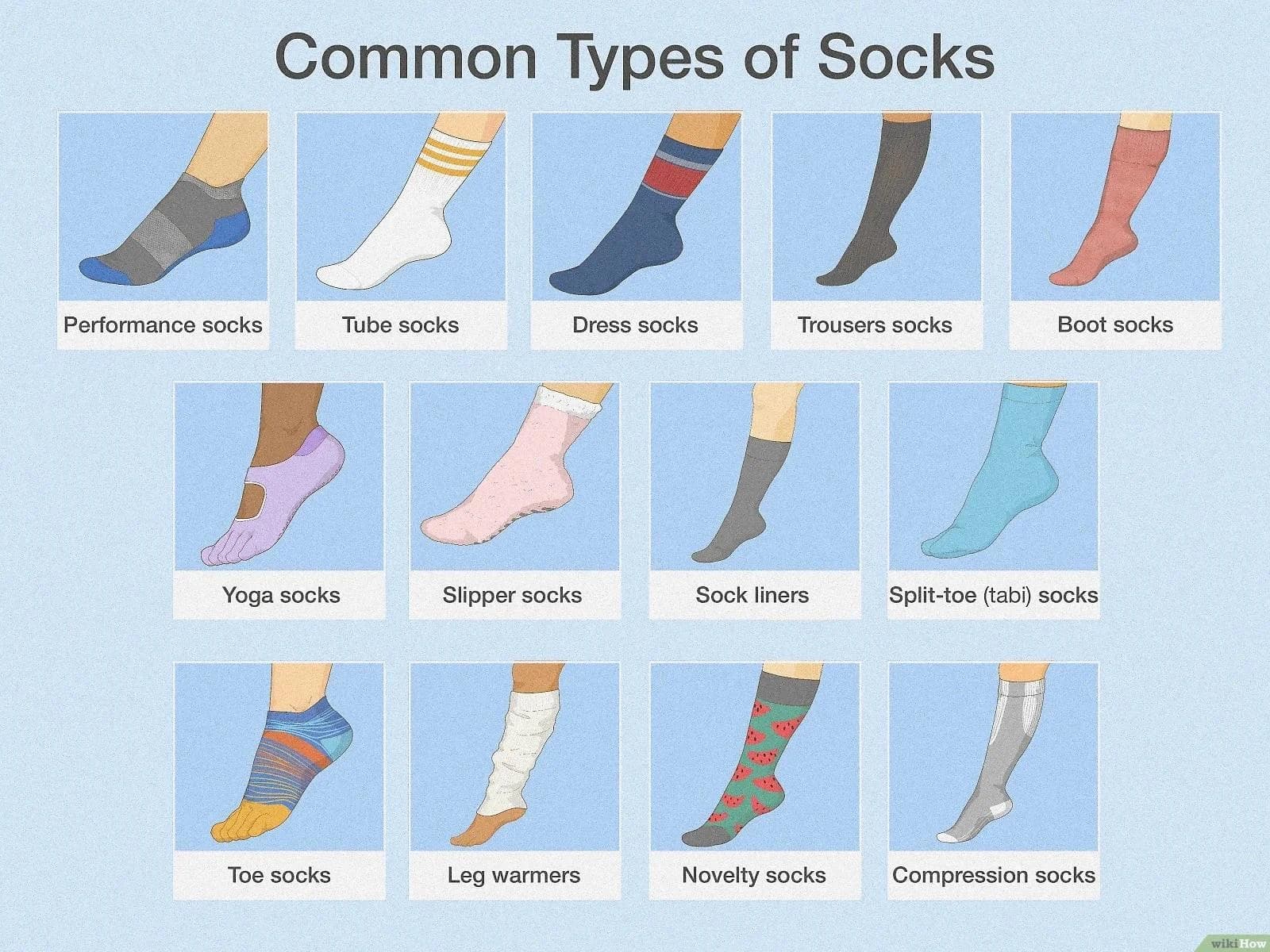
Sizing is not only about circumference and length around the foot. It is also about where the sock ends on the leg. SoxFun's height guide defines four standard leg lengths measured from heel to top: Low at 6 cm (2.36 in), Quarter at 15 cm (5.90 in), Crew at 26 cm (10.23 in), and Knee-High at 46 cm (18.11 in).
The height choice changes the fit problem. A low or quarter sock is mostly a foot-fit question. A crew sock introduces calf tension: if the cuff is too tight, it leaves a mark; if too loose, the sock slides down inside a boot or shoe. A knee-high introduces calf circumference as a variable that standard S/M/L sizing does not fully address-fit specialists recommend testing knee-high samples on multiple wearers with different calf measurements before committing to a full run. SoxFun's height guide is a starting point, not a substitute for a physical sample when the sock is going above the ankle and the fit needs to hold through a full day of wear.
What the guide does not say-but implies
A size chart tells you what sizes exist. It does not tell you what happens when a size is wrong. That is where the production model matters.
SoxFun's 50-pair minimum and free 24-hour mockups are not sizing features in a narrow sense, but they function as sizing risk controls. A 50-pair test order lets a buyer validate a size split on a real cohort before scaling to 500. A mockup approved at the design stage confirms the sock shape and proportions before the knitting program runs. The alternative-ordering a large run off a shoe-size guess and discovering the heel placement is off after delivery-is the most expensive sizing mistake in the category, and it is the one the guide is designed to prevent.
The guide ends with an offer that is worth taking literally: send the group's shoe sizes, specify men's or women's, and let the production team recommend the split. That is not a sales gesture. It is a recognition that sizing at volume is a judgment call, and the supplier who runs the knitting program sees more size distributions than any individual buyer ever will.
The takeaway for buyers
Custom sock sizing is not complicated, but it is sequential. Decide whether one size or a split fits the audience. Measure foot length where precision matters. Choose a height that matches the wear pattern. And use a low-minimum test order to confirm the fit before the full run. Do those four things in that order, and the socks arrive as a brand asset rather than a bin of unusable inventory.
The size guide is the map. The sample is the proof. The order that follows both is the one that gets worn.